Supreme Court clears way for Trump to keep building White House ballroom

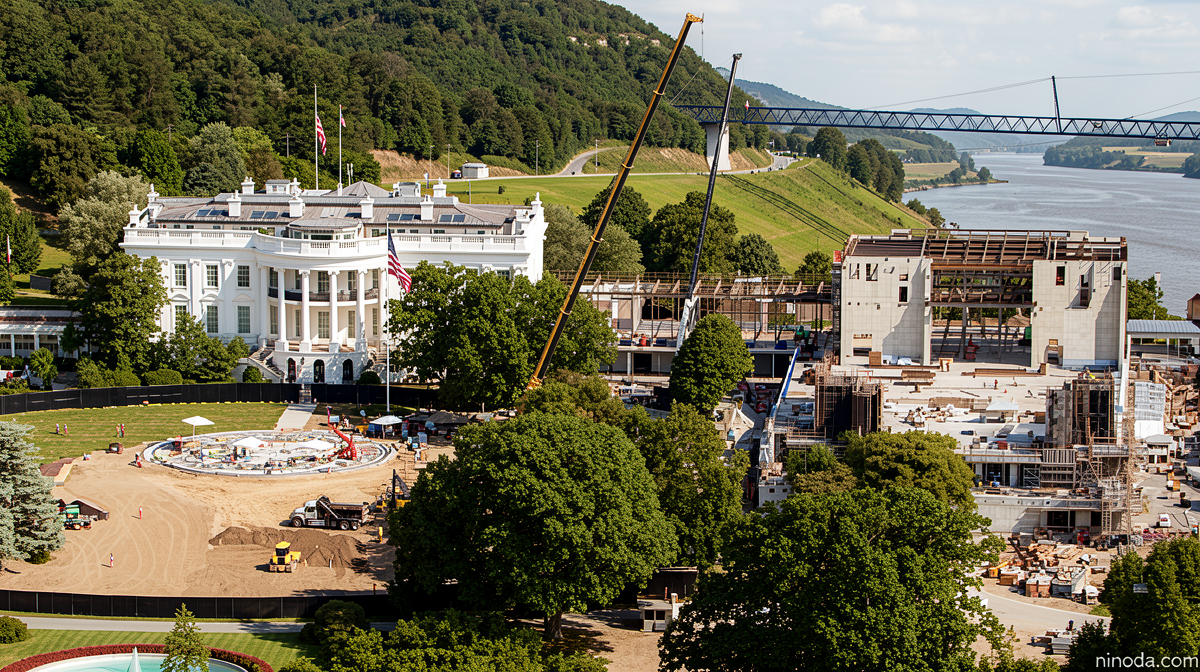
Table of Contents
Supreme Court Greenlights White House Ballroom, Splitting Over Presidential Power Over Federal Property
Ninoda.com – The United States Supreme Court has handed President Donald Trump a decisive legal victory, clearing the path for continued construction of a $400 million (£297 million) ballroom attached to the White House. In a narrow 5-4 decision issued Monday via an unsigned order, the justices granted the administration’s emergency petition and effectively nullified lower-court injunctions that had sought to freeze work on the above-ground elements of the project. The ruling arrives as cranes and crews remain active on the South Lawn helipad and the ballroom structure itself, with construction crews photographed at work as recently as 24 August 2026 in Washington, DC.
A Narrow Split Over Standing and Separation of Powers
The case was brought by the National Trust for Historic Preservation, which contended that no president possesses unilateral authority to raze and rebuild a portion of the executive residence without congressional authorization. The trust’s legal theory rested on the argument that Congress, not the executive branch alone, controls the disposition of historic federal structures.
Five justices concluded that lower tribunals had “likely exceeded” their authority in issuing the construction freeze. The majority did not reach the merits of whether the East Wing demolition was lawful. Instead, it held that the preservation organization “lacks standing” to bring the suit against the government, and that the Trump administration had demonstrated a likelihood of success in showing it would “suffer irreparable harm without a stay.”
Chief Justice John Roberts, a conservative appointee, broke ranks with his ideological colleagues and joined the three liberal justices in dissent. In his written opinion, Roberts called the project “likely unlawful” in the absence of congressional approval and warned that the majority’s reasoning undermined a foundational constitutional principle:
“Today’s decision is no victory for the separation of powers.”
Roberts further argued that the injuries described by the trust’s declarant were adequate to permit the litigation to proceed, directly contradicting the majority’s standing determination.
Trump’s Reaction and Stated Motivations
The president responded swiftly on social media, declaring himself “pleased” that what he called a “baseless” lawsuit had failed to stop the work. He framed the ballroom as emblematic of a broader national moment:
“We are living in the Golden Age of America, and this Building will be one of the Greatest ever constructed in Washington, DC.”
Trump has long advocated for a larger events space within the White House complex. More recently, he has tied the project to personal security concerns, pointing to an alleged assassination attempt at the White House Correspondents’ Association dinner in April as evidence that the existing layout leaves the president exposed during public engagements. The administration has stated the ballroom will be “substantially” complete by November and fully finished by August 2028.
The Preservation Challenge and the Question of Standing
The National Trust for Historic Preservation built its case around testimony from Alison Hoagland, a Washington, DC resident who serves on the trust’s board of trustees. Hoagland, who says she visits the surrounding neighbourhood roughly once a month, described the anticipated harm in personal and professional terms:
“I would suffer both professional and personal injuries, including to my aesthetic, cultural and historical interests, if a ballroom of the proposed form and scale were constructed.”
The majority found that description insufficient to confer Article III standing, while Roberts disagreed, viewing the claimed injuries as adequate to keep the case alive. The trust, in a post-ruling statement, expressed disappointment at the outcome but praised the “strong dissent” from the chief justice. It reiterated its core institutional position:
“Each President is a temporary steward of the People’s house and does not have the unilateral authority to demolish and redesign it without the approval of Congress.”
Broader Implications for Washington’s Cityscape
The ballroom and the accompanying South Lawn helipad are components of a sweeping programme of physical transformation that the president has outlined for the capital. Announced plans include renovation of the Lincoln Memorial Reflecting Pool and construction of a triumphal arch dubbed the “Arc de Trump,” intended to exceed in scale the Arc de Triomphe in Paris. Together, these projects represent an unprecedented scale of executive-driven alteration to landmarks that have stood for decades or centuries.
For constitutional scholars, the ruling’s most consequential element is not the ballroom itself but the standing analysis. By concluding that a preservation organization with board-level members who visit the area monthly cannot sue to challenge the demolition of a historic federal structure, the majority has narrowed the channels through which private parties can police executive action on public property. Roberts’s dissent signals that at least one conservative justice views that narrowing as a departure from the checks-and-balances architecture the Constitution was designed to enforce. Whether future cases will revisit the standing question — or whether Congress will act to clarify presidential authority over the White House grounds — remains an open question as construction crews continue their work on the South Lawn.
Related Reading
Frequently Asked Questions
What is Supreme Court clears way for Trump?
Supreme Court clears way for Trump is the main topic of this guide. The article explains the context, practical details, and next steps readers should understand.
Why does Supreme Court clears way for Trump matter?
Supreme Court clears way for Trump matters because readers are looking for a useful answer, not just a short summary. Good content should match search intent and help them decide what to do next.