Chasing a perfect sleep score? You could be making it worse

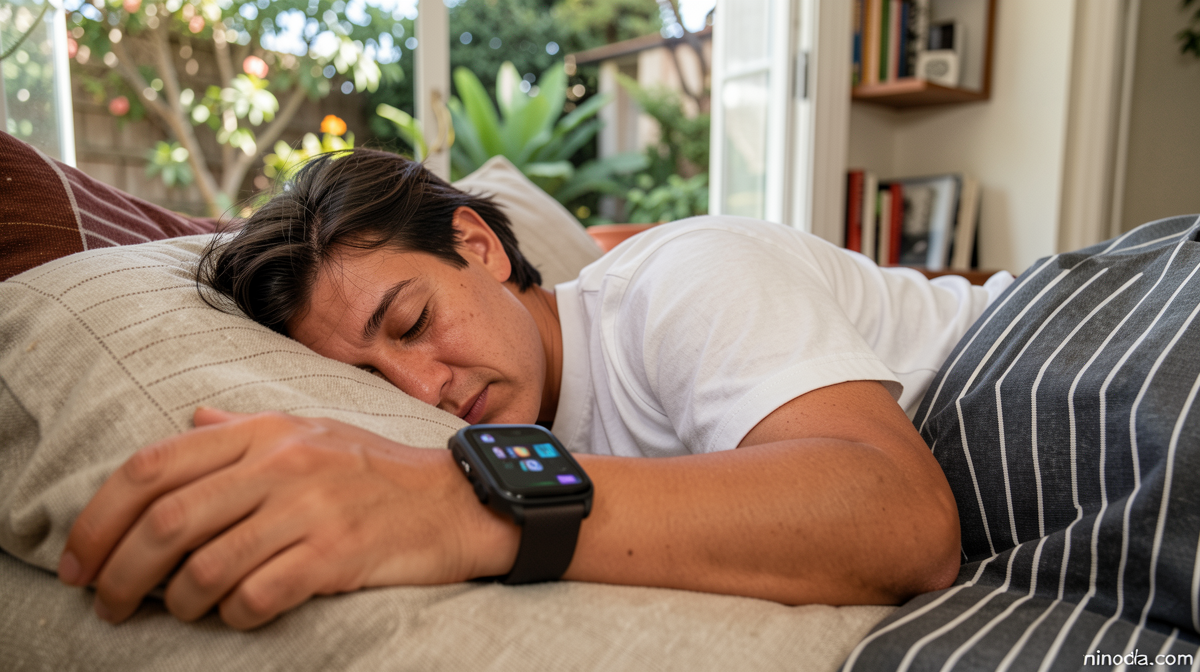
Table of Contents
The Sleep Score Trap: How Optimising Rest Became a Path to Worse Rest
Ninoda.com – Magnesium supplements, white-noise generators, smart rings that monitor every micro-movement of your wrist — the nightly ritual of falling asleep has been transformed into a data-driven performance review. The phenomenon has a name: “sleepmaxxing,” the practice of relentlessly optimising every variable around bedtime in pursuit of a flawless night. Pushed to its logical extreme, the behaviour tips into what clinicians call “orthosomnia,” a clinical label for an obsessive fixation on achieving perfect sleep metrics. Though the UK has not formally codified orthosomnia as a diagnosable condition, sleep-medicine specialists report seeing its fingerprints in clinic rooms: patients arriving with printed tracker dashboards, convinced their numbers prove a disorder that does not exist.
The irony, as these doctors caution, is that the very act of scrutinising sleep data tends to degrade the sleep it purports to protect. The question then becomes not how to score higher, but why the cultural conversation around rest grew so tangled in the first place — and what actually helps a person drift off without a spreadsheet.
From Wristband to Wellness Industry
The commercial sleep-tracking era began in 2009 with the Fitbit Classic, the first consumer fitness tracker to bundle overnight sleep analysis into its feature set. Over the following decade and a half, the category expanded rapidly. Garmin, Whoop, and Apple folded sleep-stage reporting into mainstream wrist-worn hardware, while a parallel wave of smart rings — Oura, Ultrahuman, RingConn — offered the same breakdown from a finger-mounted sensor. The output is broadly uniform across brands: a nightly report segmented into time awake, light sleep, deep sleep, and REM (rapid eye movement) phases, often crowned with a single composite “sleep score.”
That composite number, however, has no grounding in peer-reviewed sleep science. Dr Alanna Hare, a consultant in sleep medicine at Royal Brompton Hospital in London, is blunt on the point:
“There’s nothing recognised in sleep science that is a ‘sleep score.’ That’s just been created by manufacturers.”
In her view, the score is a marketing artefact dressed up as a clinical metric, and its proliferation has measurable consequences for patient anxiety.
When the Number Becomes the Diagnosis
Hare describes a growing pattern in her consultations: patients presenting tracker exports, asking pointed questions about fragmented REM or shallow deep-sleep percentages, and interpreting those figures as evidence of pathology. Reassuring medical workups have not, she notes, reliably dispelled the worry. The tracker number persists as a fixed point of anxiety, independent of objective findings.
“It’s great that there’s more focus on sleep as part of wellness. But sleep just does not respond well to attempts to perfect it.”
The anxiety loop is not merely subjective. Research out of the University of Oxford demonstrated a placebo effect of sleep scores on daytime cognition. Participants wore trackers that assigned them a nightly score; crucially, the scores were randomised and bore no relationship to actual sleep architecture. The following morning, participants self-rated mood, fatigue, and alertness, then completed objective tests of sustained attention and reaction time. Those told they had slept poorly reported greater fatigue and performed worse on the cognitive tasks — despite the fact that every score was fabricated. The number, not the night, shaped the day.
A Personal Account of Three Years of Score-Driven Living
Jess Hill, a 32-year-old HR professional based in London, spent roughly three years treating her Garmin watch as the authoritative arbiter of her nightly rest. She describes a self-fulfilling script: a low score meant she braced for a miserable, underperforming day; a high score compelled her to push through fatigue as though she were fully restored.
“I started to rely on the watch as my Bible for whether I slept well or not. I would think, ‘I’ve had awful sleep so I’m going to really struggle today,’ even if I actually probably had okay sleep.”
The obsession broke earlier this year, when the device’s output stopped tracking her lived experience. On one occasion she was awake continuously from 01:00 to 05:00 — four hours of consciousness — yet the watch reported an exemplary night. The dissonance was enough to sever the dependency.
Accuracy Under Legal Scrutiny
Questions about what these devices actually measure have moved beyond anecdote into the courtroom. A lawsuit filed last month in San Francisco alleges that Oura rings cannot accurately quantify sleep quality or discrete sleep stages, and instead lean on AI-generated estimates whose accuracy, per the complaint, is no better than a coin flip. Oura responded that it stands behind its scientific and accuracy claims and is committed to transparently communicating what the ring measures versus what it estimates, and how members should interpret that information.
The Gamification Problem
Dr Neil Stanley, a sleep researcher and author of How to Sleep Well, frames the issue in behavioural terms: attaching a numerical target to sleep converts a natural, variable biological process into a score-chasing game. Once a number exists, the brain treats it as a goal to be met, and the pressure to meet it introduces the very arousal that blocks the onset of sleep. The tracker, designed to inform, ends up instructing the nervous system to stay alert.
For readers already embedded in the ecosystem, the practical implication is not necessarily to discard the device overnight, but to decouple identity from the number. Treat the data as one noisy signal among many — body temperature, subjective grogginess, next-day mood — rather than as a verdict. The sleep that restores you is the one you stop measuring.
Related Reading
Frequently Asked Questions
What is Chasing a perfect sleep score You could?
Chasing a perfect sleep score You could is the main topic of this guide. The article explains the context, practical details, and next steps readers should understand.
Why does Chasing a perfect sleep score You could matter?
Chasing a perfect sleep score You could matters because readers are looking for a useful answer, not just a short summary. Good content should match search intent and help them decide what to do next.