‘I want to thank myself’ – Andreeva’s journey to Grand Slam glory

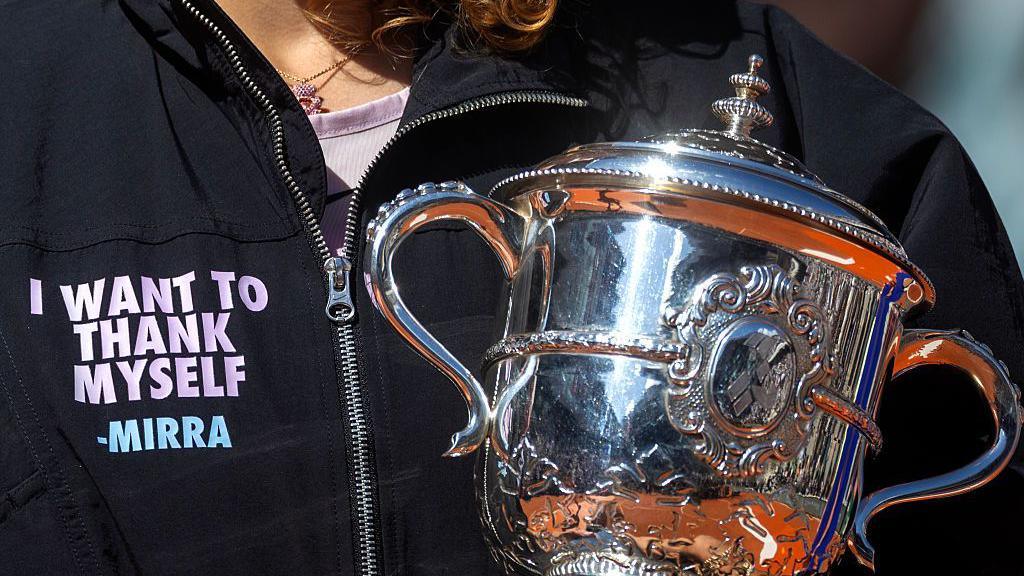
Mirra Andreeva’s Self-Complimentary Triumph at the French Open
Ninoda.com – At the age of 19, Mirra Andreeva etched her name into the history books by becoming the youngest woman to claim the Roland Garros singles title since Monica Seles in 1992. Her victory over Polish qualifier Maja Chwalinska, a 6-3, 6-2 final, marked a significant milestone in her career. Yet, what stood out most was the unique message she wore on her black jacket: “I want to thank myself.”
Following her win on Court Philippe Chatrier, Andreeva delivered a heartfelt list of acknowledgments, beginning with her opponent and moving on to tournament organizers and her support team. Her coach, Conchita Martinez, a former French Open finalist, was among those honored. However, the final expression of gratitude was reserved for herself. “I also want to thank myself for believing in myself,” she said, reflecting on her perseverance through challenges.
“For giving 100% even when it’s been tough, trying every day to be better as a person and a player, believing I can do this, fighting so many demons inside of me. Only I know how tough it was for me and how nervous I was these past two weeks, so thanks to me for working so hard and giving my best.”
Andreeva’s self-commendation echoes a phrase she “stole” from rapper Snoop Dogg, which she initially used to elicit laughter. But as her journey progressed, she realized the value in recognizing her own efforts. “Why not thank yourself?” she added, highlighting her personal growth. “You are the one that works, the one doing the job, and the one feeling all the nerves.”
A Journey of Resilience
Despite her early promise, Andreeva faced setbacks, including emotional outbursts that occasionally disrupted her focus. A notable incident occurred during last year’s Roland Garros quarter-final against Lois Boisson, where she lost her composure in front of a passionate crowd. Similarly, she had shown frustration at Indian Wells by smashing a racquet and berating the audience. However, this year’s tournament saw a marked improvement in her composure, especially in the final where Chwalinska’s unpredictable play and adverse weather conditions tested her.
Andreeva credited her psychologist, Alexis Castorri—previously associated with Andy Murray—for helping her maintain control. He advised her to “imagine a big stop sign” when emotions surged. “My psychologist says you can always choose how you’re going to be on the court, how you’re going to play, and who you’re going to be as a person as well,” she explained. “I decided to choose to be a fighter, inspired by Roger Federer’s demeanor here.”
Coach Conchita Martinez: A Pillar of Support
Since joining Martinez’s team in 2024, the Spanish coach has guided Andreeva to five WTA Tour titles. Their bond extends beyond the court, with shared humor and inside jokes, such as Andreeva’s playful jab at Mary Pierce, who defeated Martinez in the 2000 Paris final, during the trophy ceremony.
During a Wimbledon invitational match last year, Andreeva cheered for Martinez in a tennis-themed straw hat and with a homemade “Let’s go Senorita” sign. “She told me she’s very proud of me,” Andreeva shared. “To hear those words from her is very, very special to me.”
A New Era in Grand Slam History
Andreeva’s victory cements her as the first player born after 2005 to win a Grand Slam title. This season, she has thrived on clay, securing 22 of her 25 matches—more than any other WTA Tour player on the surface. Her success has also reignited hope for Russian women in tennis, following Maria Sharapova’s last major singles win. “Andreeva is showing the signs,” Sharapova remarked, underscoring the young star’s potential.