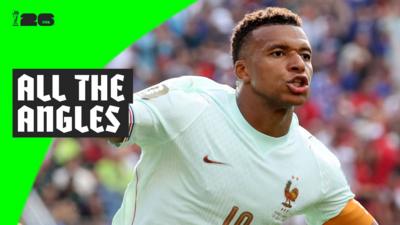
Most clinical? Least creative? Best in the air? Comparing the last four

Comparing the Final Four: Efficiency, Creativity, and Aerial Play
Ninoda.com – The World Cup semi-finals have narrowed the field to four teams: Argentina, England, France, and Spain. As the competition enters its final stages, analysts are dissecting their performances to predict the ultimate winner. With the tournament’s outcome hanging in the balance, key metrics reveal distinct strengths and weaknesses among the contenders.
Goal Scoring and Shot Statistics
All four teams have played six matches, but Argentina’s extra time games added an hour to their total playing time, while England’s added half an hour. Adjusting for this, Argentina emerged as the most efficient in converting chances, scoring 17 goals. France, however, showcased a more consistent attack, averaging the most goals, recording the highest number of shots, and leading in Expected Goals per 90 minutes.
“The fact that Argentina have the worst aerial duel success rate of the final four should give England hope that their threat in the air can continue.”
Spain, despite taking 110 shots like France, scored fewer goals—11 compared to 16. This suggests a lower conversion rate, with only 18% of their chances resulting in goals. Meanwhile, England balanced precision and productivity, scoring over two goals per game due to the sharp finishing of Jude Bellingham and Harry Kane, though their creativity lagged behind the others.
Defensive Resilience and Physical Effort
Spain demonstrated a strong defensive record, allowing only one goal in the quarter-finals against Belgium. France, on the other hand, conceded just two goals in six games, indicating a solid defensive unit. However, Spain’s physicality stood out: they ran more, sprinted more, and pressed opponents more aggressively than any other semi-finalist. Argentina, while covering the most distance (706.5km), ran the least per game when accounting for playing time, and their high-pressure tactics were less frequent than England’s.
Possession and Passing Accuracy
Spain dominated possession with 66%, the highest of any team at this World Cup. They also matched Argentina’s passing accuracy (90.4%), making them the most technically sound group. England and France, though less dominant in ball control, still maintained high proficiency in passing. France’s cross-field precision, however, was notable, with their players successfully finding teammates in one out of every four open-play deliveries.
Argentina’s reliance on Lionel Messi’s playmaking was evident. The captain orchestrated 15 key passes, the most of any player at the tournament. Yet, his teammates rarely attempted similar feats, highlighting a team dynamic that prioritized Messi’s individual brilliance. England’s defenders will need to be vigilant against Argentina’s quick one-twos and through balls, which have been a recurring threat.
Key Matchups and Tactical Outlook
France’s attacking trio—Mbappe, Giroud, and others—pose a formidable challenge, especially against Spain’s disciplined defense. The clash between these two could determine the final champion. Meanwhile, the England vs. Argentina match promises high-scoring action, as both have allowed six goals each. England’s vulnerability at the back may be exploited by Argentina’s aerial threats, led by Messi’s ability to create opportunities from set pieces.
As the final showdowns approach, the narrative shifts from statistical dominance to tactical execution. Who will prove unstoppable on the pitch? The answer may lie in the balance between France’s attacking firepower and Spain’s defensive solidity, or England’s adaptability against Argentina’s flair.
For more insights, explore BBC Sport’s coverage of the tournament’s iconic moments, including the “Animals” and “Hand of God” controversies, and the historic rivalry between Argentina and England. Fans can also vote for their ideal semi-final XI, featuring stars like Lamine Yamal, Mbappe, and Kane.