Red card system in disarray over Trump, Fifa and Balogun decision

Red Card System in Disarray Over Trump, Fifa and Balogun Decision
The Controversial Red Card Suspension
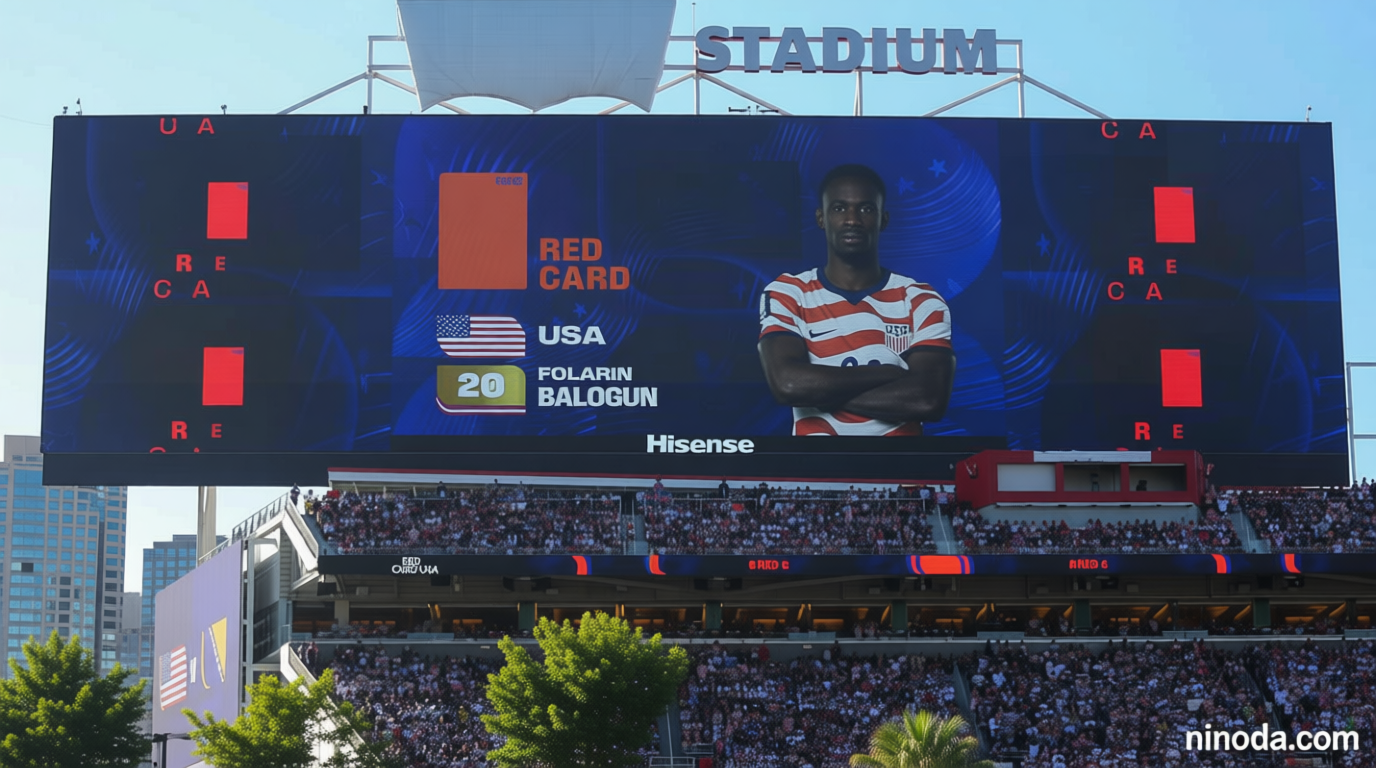
Ninoda.com – The red card system in disarray has become a focal point of debate in international football, following the recent decision to overturn Folarin Balogun’s red card during the U.S. team’s last-32 clash against Bosnia-Herzegovina. This move has raised eyebrows, as it challenges the long-standing rule that a red card at the World Cup automatically results in a suspension for the next match. Balogun, who scored three crucial goals for the U.S. in the tournament, was sent off for a serious foul play but will now play Belgium in the last-16 without facing any disciplinary action. This anomaly has sparked discussions about the fairness and consistency of the red card system in disarray.
Historically, the red card system has been a cornerstone of maintaining order in competitive matches. Before the 1962 World Cup, disciplinary decisions were made manually by committees, allowing for some flexibility. However, since then, the automatic two-match suspension for red cards has been a widely accepted standard, with only two players in World Cup history escaping such penalties. The last was Garrincha of Brazil, who received a red card in the semi-final but returned for the final. Now, Balogun’s case appears to be the first in decades where this rule is being actively questioned, suggesting a possible shift in how disciplinary actions are handled.
Political Influence and FIFA’s Role
Recent reports indicate that the red card system in disarray may have been influenced by political factors, with U.S. President Donald Trump reportedly calling FIFA president Gianni Infantino to request a review of Balogun’s red card. While the BBC has not yet confirmed these claims, the connection between the White House and FIFA has drawn significant scrutiny. The disciplinary committee’s reliance on Article 27 of its code, which grants FIFA the authority to override decisions, has been highlighted as a potential loophole. This provision, rarely used in World Cup history, now seems to be invoked to create a precedent that could affect future disciplinary processes.
Comparisons to past cases have underscored the irregularity of Balogun’s situation. For instance, Cristiano Ronaldo’s red card in a qualifier was overturned with a clear justification—his clean record of 225 international appearances. Balogun, however, received no such reasoning, leaving many to question whether the decision was based on objective criteria or external pressures. This discrepancy has led to calls for transparency, as the red card system in disarray risks being perceived as biased or politically motivated.
Other instances of leniency before tournaments have occurred, such as the suspension of Laurent Koscielny in 2014 or the cases of Moises Caicedo and Nicolas Otamendi. Yet, Balogun’s situation feels more politically charged, with the U.S. team left without clarity on the reasons for the reversal. BBC Sport pundit Micah Richards, a former England defender, called the move a farce.
“To have it suspended for a year makes a mockery of the whole tournament,” he said.
His critique highlights the growing concerns about the integrity of the red card system in disarray.
Implications for Future Tournaments
The decision has broader implications for the red card system in disarray, potentially altering how teams approach disciplinary appeals in future tournaments. If FIFA can override red card sanctions with minimal justification, it may encourage teams to challenge decisions, especially in high-stakes matches. This could lead to a scenario where the severity of fouls is downplayed in favor of political or strategic considerations, undermining the fairness of the system.
Additionally, the incident has reignited debates about the role of politics in football governance. FIFA, as the governing body, has long faced criticism for its decision-making processes, and this case may further fuel those concerns. While the red card system in disarray is designed to enforce discipline, its perceived susceptibility to external influence raises questions about its reliability. The outcome of Balogun’s case could set a new standard for how disciplinary actions are handled, particularly in matches involving host nations or influential political figures.
As the tournament progresses, the red card system in disarray will likely remain a topic of discussion. Fans and analysts are now closely watching how FIFA manages similar situations in the coming matches, hoping for transparency and consistency. The decision to overturn Balogun’s red card has already sparked a conversation about the balance between enforcing rules and accommodating political pressures—a conversation that may shape the future of football’s disciplinary framework.