Fears for children’s safety in West Bank school as settler attacks rise

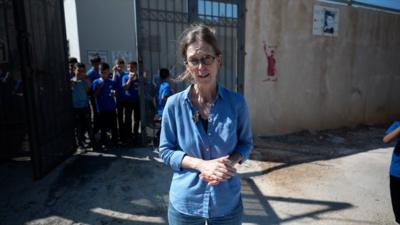
Table of Contents
Barbed Wire Now Rings a West Bank School as Families Brace for Another Season of Violence
Ninoda.com – Parents in a small Palestinian village north-east of Ramallah have watched their children’s school become an island of barbed wire, a physical barrier erected not against weather or wildlife but against the growing threat of settler violence. The fencing, coiled around the perimeter of the campus in al-Mughayyir, is meant to keep intruders out. It is also, for many families, a daily reminder that the ordinary act of sending a child to class has become an act of calculated risk.
A Village Hemmed In
Al-Mughayyir sits in the occupied West Bank, a community that has found itself encircled over recent years by a proliferation of Jewish settler outposts. Where once the village could be reached along open roads, Israeli military forces now regularly seal off the main entrance, operating what amounts to an improvised checkpoint. Residents describe being stopped, questioned, and delayed on their way to work, school, or medical appointments — a routine that has become woven into the fabric of daily life.
The outposts themselves are a source of particular frustration. While the larger, government-sanctioned settlement blocs have existed for decades, many of the smaller structures that have sprouted around al-Mughayyir were built without formal planning permission. Under Israeli domestic law, these ad-hoc outposts occupy a grey zone: they are often deemed unauthorized, yet they persist, backed by military protection and connected to the broader settlement infrastructure of roads, water lines, and electricity.
Deadly Toll in a Single Year
The human cost of this encirclement has been stark. Six people have been killed in al-Mughayyir over the course of the year, a figure that includes three pupils attending the very school now ringed with wire. The deaths represent a sharp escalation in settler-related violence directed at Palestinian residents, a pattern that has intensified across the West Bank in recent months.
Among the dead was 14-year-old Aws al-Naasan, a student shot and killed by a settler outside the school gates in April. His death transformed an abstract fear into a concrete wound for the village. For parents who had already been anxious about sending their children through a checkpoint-laden corridor to reach the campus, the shooting removed any remaining ambiguity: the danger was not hypothetical. It was at the gate.
The Legal Landscape
Under international law, all Israeli settlements in the occupied West Bank are considered illegal. This position, affirmed by successive United Nations General Assembly resolutions and endorsed by the International Court of Justice, rests on the principle that a occupying power may not transplant its own civilian population into territory it administers. The settlements, and the outposts that feed into them, therefore exist in a state of permanent legal contestation.
Within Israel’s own legal framework, the picture is layered. The large settlement blocs — Gush Etzion, Ma’ale Adumim, and others — were established under planning processes and carry a degree of domestic legitimacy. The smaller outposts, however, frequently lack building permits or land-use approvals. Their existence is tolerated, sometimes encouraged, by political authorities who view them as instruments of territorial consolidation, yet they remain technically unlawful under Israeli planning statutes.
What the Wire Tells Us
The decision to fence a school with barbed wire is not a routine infrastructure upgrade. It signals that the community has concluded the threat environment has crossed a threshold where passive coexistence with neighboring outposts is no longer tenable. The wire does not solve the underlying problem — it merely draws a line and hopes the next attack will come from a different direction.
For the families of al-Mughayyir, the implications extend beyond the schoolyard. Children who walk to class past a military checkpoint, past outpost perimeters, past the memory of a classmate’s body at the gate, carry that landscape with them. The psychological weight of repeated near-misses, of sirens, of parents arriving at school to find the gates locked and the wire humming, shapes a generation’s relationship with its own neighborhood.
Broader observers note that the pattern in al-Mughayyir — a village squeezed between outposts, policed at its entrance, and now armored around its most vulnerable institution — mirrors dynamics in dozens of other Palestinian communities across the West Bank. Each case is locally specific, but the architecture of pressure is recognizable: incremental encirclement, sporadic lethal incidents, and a slow erosion of the space in which ordinary life can be conducted without constant vigilance.
The barbed wire around the school will not be removed. The checkpoint at the village entrance will not be dismantled. What remains uncertain is whether the next year will bring another name to the list of the dead, or whether some combination of political pressure, international intervention, or local negotiation will alter the trajectory. For now, the wire stands, and the children walk to class through it.
Related Reading
Frequently Asked Questions
What is Fears for children s safety in West?
Fears for children s safety in West is the main topic of this guide. The article explains the context, practical details, and next steps readers should understand.
Why does Fears for children s safety in West matter?
Fears for children s safety in West matters because readers are looking for a useful answer, not just a short summary. Good content should match search intent and help them decide what to do next.