School protests send shivers down French government’s spine

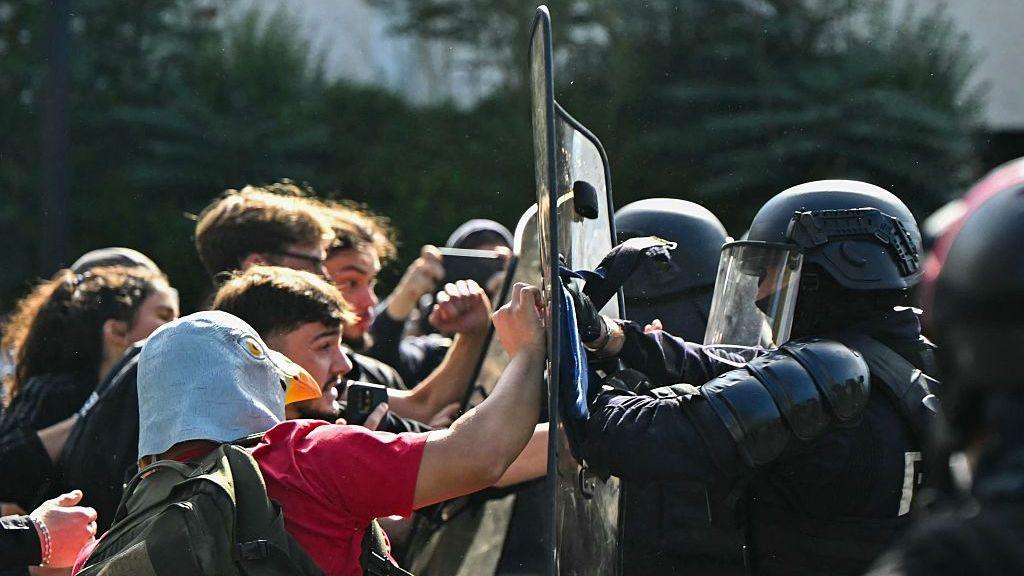
Table of Contents
French School Protests Raise Pressure on Macron’s Government
Ninoda.com – Demonstrations by secondary-school students have spread from the northern Paris suburbs to towns and cities across France, creating a volatile challenge for President Emmanuel Macron’s government as the country moves toward a presidential election year.
The movement began nearly two weeks ago in Seine-Saint-Denis, a lower-income department north of Paris. It has since reached hundreds of lycées, the schools attended by many French teenagers aged 15 to 18. On Thursday, blockades affected schools nationwide; by Friday, roughly 400 lycées had been shut as a precaution for pupils and staff. University students are also beginning to take part.
The atmosphere at many gatherings has been described as energetic rather than uniformly furious, but ministers have ample reason for concern. French political history has repeatedly shown that student unrest can move quickly beyond its original demands, attract other social groups and become difficult to contain.
A familiar political fear
French leaders remain deeply conscious of the student-led upheaval of May 1968, when protests and strikes shook the authority of President Charles de Gaulle. De Gaulle used the term chienlit—a crude expression suggesting disorder and chaos—to describe the unrest. The events became a lasting warning to governments about the force of young people mobilising in public spaces.
Youth movements can be especially unsettling for authorities because they often lack a single hierarchy or recognised leadership able to negotiate on behalf of everyone involved. Their demands may develop as the movement grows, while images of teenagers facing police can prompt wider public sympathy. Any serious injury during confrontations risks escalating the political consequences.
That sensitivity is heightened by the election calendar. With a presidential contest only months away, the government must weigh public order, the safety of school communities and the danger that a heavy-handed response could worsen the crisis.
Schools damaged and injuries reported
The protests have not remained peaceful everywhere. A fire destroyed the main hall of a lycée in Nantes on Thursday, while smaller fires were set near school entrances in several places. Damage is expected to cost millions of euros.
Education Minister Édouard Geffray said 65 education workers had been injured, including 40 school heads. He said many of those hurt believed they were confronted by people who were not students at their own schools.
“Most of the staff who were hurt said that the people they were facing… were not their own pupils,” he said.
The government has also said that about 300 police officers and firefighters received treatment for injuries, and that around 2,000 people—mostly minors—were taken into custody. Student organisations, meanwhile, have compiled their own accounts of injuries attributed to police action. Two teenagers suffered serious eye injuries, and another lost many teeth.
These competing accounts underline why the protests are so politically delicate. Protecting school staff and preventing property damage are immediate concerns, but allegations of excessive force can rapidly become central to the debate and expand support for demonstrators.
Education funding at the heart of the protests
Students’ demands have not always been expressed through a single detailed programme, but their concerns centre on resources. They want more teachers, smaller classes, improved buildings and additional support such as school nurses. These are issues with broad resonance in a country where public education is widely viewed as a core national responsibility.
Financial constraints, however, limit the government’s room to respond. Prime Minister Sébastien Lecornu has presented a draft budget for the coming year built around significant spending reductions. He has pledged to seek €54bn, or £46bn, in savings from public expenditure.
Whether that target can be achieved remains uncertain. Yet the proposed direction of travel makes it difficult for ministers to answer calls for more staffing, renovation work or expanded services at schools. Requests that might previously have been eased through additional funding now collide with a broader effort to restrain the state budget.
For students, an argument about classroom conditions is practical and immediate: overcrowded rooms, insufficient adults and deteriorating facilities affect daily life. For the government, each concession carries a wider fiscal and political meaning. The tension between those two perspectives is helping turn a local education dispute into a national test.
Concerns over political involvement
The unrest is also being viewed through the lens of France’s increasingly polarised politics. Figures on the centre and right argue that France Unbowed, known as LFI, is seeking to influence or amplify the student movement. LFI representatives have appeared alongside protesters, including in Saint-Denis.
Jean-Luc Mélenchon, LFI’s prominent presidential candidate, has become a focal point in those accusations. Bally Bagayoko, the mayor of Saint-Denis, drew criticism after saying that violence can sometimes be legitimate.
“Violence can sometimes be legitimate.”
Such statements deepen anxieties that the school protests could become part of a wider confrontation between political camps. The students’ concerns about education funding are real, but the debate around them now includes questions about outside participation, public safety and the possibility of further unrest.
The government’s task is therefore larger than reopening closed schools. It must find a way to address legitimate frustration in the education system while preventing a cycle in which blockades, violence and political accusations reinforce one another. France has long learned that when young people take to the streets, the effects can extend far beyond the school gates.
Related Reading
Frequently Asked Questions
What is School protests send shivers down French?
School protests send shivers down French is the main topic of this guide. The article explains the context, practical details, and next steps readers should understand.
Why does School protests send shivers down French matter?
School protests send shivers down French matters because readers are looking for a useful answer, not just a short summary. Good content should match search intent and help them decide what to do next.