
Riot police clash with students as education protests rage in France

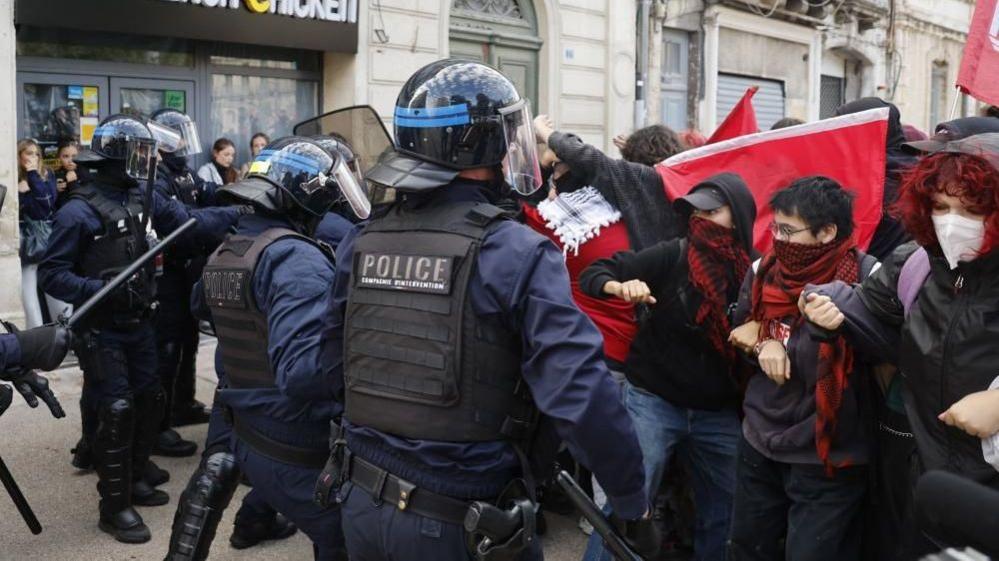
Table of Contents
Student unrest closes hundreds of French schools as education complaints intensify
Ninoda.com – Thousands of students took to the streets across France on Friday, bringing disruption to more than 700 schools and prompting repeated confrontations with riot police. What began with blockades in Paris last week has grown into a nationwide movement centred on dissatisfaction with teaching conditions, crowded classrooms and deteriorating school buildings.
Demonstrations have spread to cities including Montpellier, Nantes and Marseille. In several places, pupils and other participants blocked school entrances, set up barricades or gathered outside campuses. Fires were reported in streets, while rubbish bins were burned in Rennes and Paris.
The unrest is unfolding at a sensitive political moment, six months before France’s next presidential election. Planned budget reductions affecting education have added to the anger among young protesters, who argue that schools are already struggling with inadequate resources.
Concerns over staffing, buildings and long school days
Students have highlighted a range of day-to-day concerns: lengthy school hours, overheated classrooms and staff absences. Their complaints also include a shortage of teachers, classes with too many pupils and school premises in poor condition.
For many participants, the closures themselves have become a sign that their demands are being noticed. Lola, a 16-year-old demonstrator, said the shutdown of her school represented a success for the movement.
“As far as we’re concerned, we’ve won – our school is closed this morning.”
She said the police response had deepened frustration among students.
“It makes us even angrier – the police have no right to hit us or use tear gas on us.”
The education ministry said at least 65 staff members had been injured during the disorder. It also said school sites had suffered significant damage, including attacks on gates, entrances and fences.
Police response and arrests
Police have used a range of crowd-control measures as tensions rose. In Pantin, a suburb of Paris, officers charged protesters and made arrests after objects were thrown at them. Tear gas was used in Strasbourg amid fears that the situation could become more hostile.
In Belfort, in north-eastern France, a 17-year-old was arrested on suspicion of attempted homicide after an incident in which a police officer was targeted. Authorities released images of items seized during protests, including petrol bombs, an axe and mortar-style fireworks.
Gérald Darmanin said the demonstrations had moved beyond ordinary student action and become a public-order issue.
“Gone from high-school student demonstrations to a public order disturbance.”
He said roughly 2,000 people, most of them children, had been taken into custody since the movement began. Prosecutors were asked to pursue parents for the cost of damage caused by their children, with Darmanin saying they should pay for repairs.
Costly damage at Nantes school
One of the most serious incidents occurred at Nelson Mandela high school in Nantes. Fire destroyed the building’s glass entrance and damaged areas inside the school. The regional government put the cost of the damage at more than €2m, or about £1.7m.
The destruction has sharpened a difficult contradiction at the centre of the protests. Students are demanding better school environments, yet damage to educational facilities can leave communities facing further disruption and expensive repairs. Schools affected by fires or vandalism may be unable to reopen normally until safety checks and restoration work are completed.
Education Minister Édouard Geffray said people who were not students had entered the movement. He said teachers had identified some of those involved as unfamiliar faces rather than their own pupils.
“The people in front of me were not my students.”
That claim has become part of the broader debate over whether the protests can remain focused on education or will be overshadowed by violence. The distinction matters for students seeking to press their concerns while avoiding the consequences of confrontations that can lead to injuries, arrests and school damage.
Parents and unions react
Parents have expressed growing anxiety as school demonstrations become more volatile. At the Claude Monet school in southern Paris, Anya, 53, went looking for her son after he left home despite being told not to attend.
“We banned him from coming. I hope he isn’t here, but he did leave the house. We’re afraid the situation might escalate.”
Several unions have backed the students, including SNEP-FSU, SNUEP-FSU and Solidaires. The Solidaires Trade Union Federation called for support for the young demonstrators and stressed that secondary-school pupils have rights to assemble, associate and demonstrate.
“Let’s not let them fire on our children.”
The scale of the protests puts renewed pressure on the government to respond to concerns over school funding and working conditions. Whether officials can address those issues while restoring calm will shape the next stage of a movement that has rapidly reached schools throughout the country.
Related Reading
Frequently Asked Questions
What is Riot police clash with students as education?
Riot police clash with students as education is the main topic of this guide. The article explains the context, practical details, and next steps readers should understand.
Why does Riot police clash with students as education matter?
Riot police clash with students as education matters because readers are looking for a useful answer, not just a short summary. Good content should match search intent and help them decide what to do next.