Chris Mason: What his first week in power tells us about Andy Burnham

Andy Burnham’s Manchester Era: Early Signals from the New Prime Minister
A Fresh Power Center Takes Shape
Ninoda.com – Andy Burnham has established his headquarters in Manchester, declaring this location marks the start of “the biggest rebalancing of power our country has seen.” The new prime minister also promised he will be “bringing forward the biggest changes in the last 40 years.” However, his initial announcements have been somewhat fragmented compared to such ambitious claims. Burnham indicated that his comprehensive “10 year plan for Britain” will arrive later this year.
Historical precedent suggests caution here. Both Boris Johnson and Sir Keir Starmer previously discussed decade-long visions, though both ultimately faded faster than anticipated. The early indicators—acknowledging we are merely days into this administration—suggest Burnham appears sharper and more agile than Starmer when articulating his objectives and demonstrating tangible examples through recent announcements.
Government Machinery Gets a Refresh
Structural adjustments signal where authority now concentrates. The creation of the Office of Prime Minister and the establishment of No 10 North demonstrate that power flows prominently through Burnham’s new base. He hopes these changes address criticisms leveled at Starmer, who faced frustration over pulling levers without seeing results.
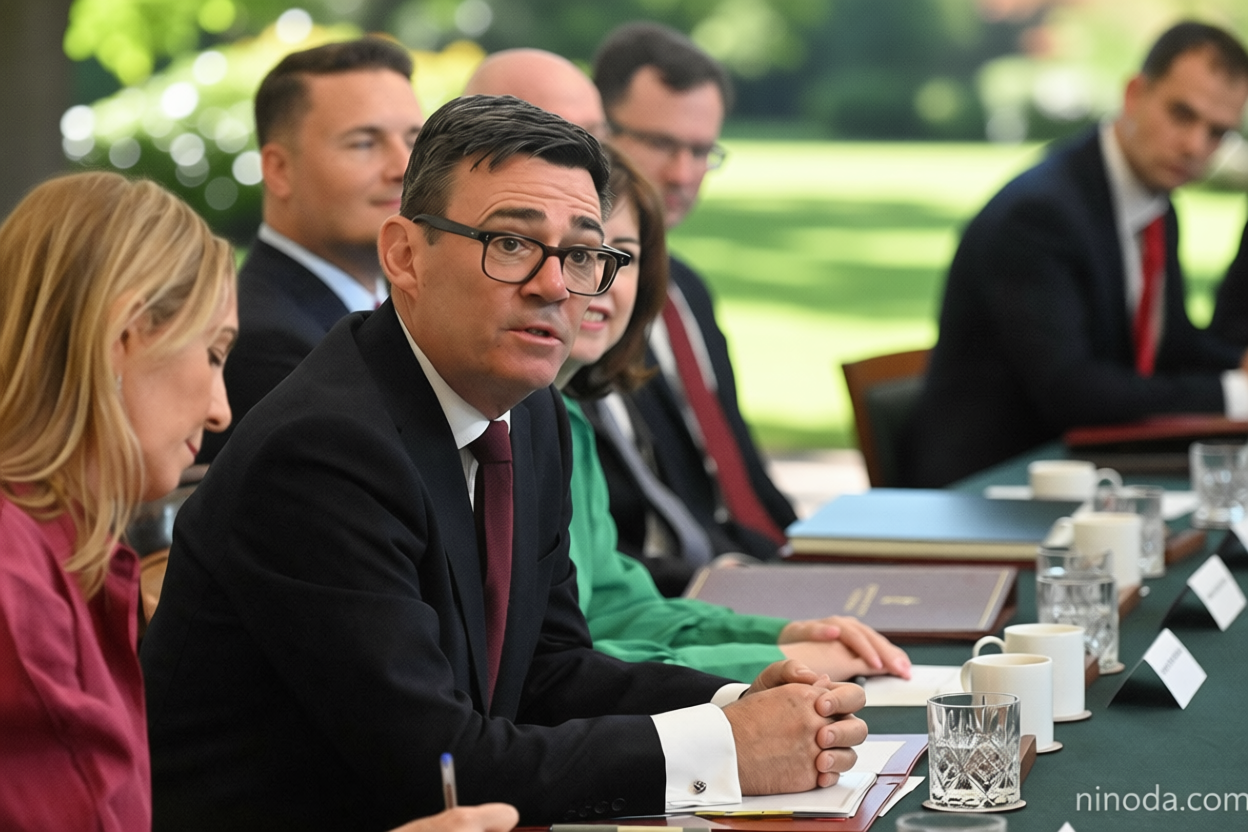
Angela Rayner, returning to the cabinet as housing secretary after serving as deputy prime minister, emphasized urgency to the BBC’s Today programme on Friday: “We are on borrowed time if we don’t get a move on.” Today, Burnham is gathering what Rayner describes as “a pride of mayors” alongside other officials for a National Economic Council meeting at the new Manchester headquarters.
Opposition Recalibrates
Political opponents must adjust to the new landscape. Conservative leader Kemi Badenoch delivered an outdoor speech and held a news conference on a central London rooftop on Thursday—a clear acknowledgment that political dynamics have shifted. She playfully noted Burnham’s casual manner, remarking that “he seems like a nice guy…I’m glad he’s got a sense of humour,” before delivering her substantive critique.
“Is that it?” Badenoch questioned, adding: “He is behaving like he’s still the mayor of Manchester. He is now the prime minister of the United Kingdom.” She characterized his proposals as superficial and insufficiently detailed.
Rapid-Fire Challenges Emerge
Despite Burnham’s efforts to project responsiveness to cost-of-living concerns, the pace of demands has already accelerated. Domestically, his call for a “pause” on early prisoner releases in England and Wales illustrates governing dilemmas—overcrowded facilities necessitate difficult prioritization among offenders eligible for release.
Internationally, complications arose after Burnham renewed American authorization to utilize British airbases for “defensive” strikes against Iran. Tehran subsequently declared these bases legitimate targets. Meanwhile, Middle Eastern tensions continue escalating, driving oil prices upward once again.
Big Promises Meet Scrutiny
Burnham’s ambitious pledges now face practical examination. He committed to “the biggest council house building programme since the post war period,” yet questions remain regarding funding mechanisms and precise definitions. Matt Chorley’s BBC Radio 5 Live interview with Rayner highlighted this uncertainty—the housing secretary struggled to specify when the “post war period” concluded, leaving no numerical benchmark for what initially appeared an expansive commitment.
These early days reveal both opportunity and vulnerability for Burnham’s administration as it navigates immediate pressures while attempting to establish its distinctive approach to governance.