Devastating European wildfires in maps – and how they’re being tackled

Ninoda.com – “`html
Europe’s Burning Crisis: Maps and Response Efforts
Across France and Spain, massive wildfires are currently displacing over 300,000 residents from their dwellings. French authorities report this represents their most severe fire season in twenty years, while Madrid officials describe the situation as unprecedented for their region. These devastating blazes arrive after a sweltering European summer where numerous locations recorded temperatures exceeding 40 degrees Celsius (104 degrees Fahrenheit).
Madrid’s Historic Conflagration
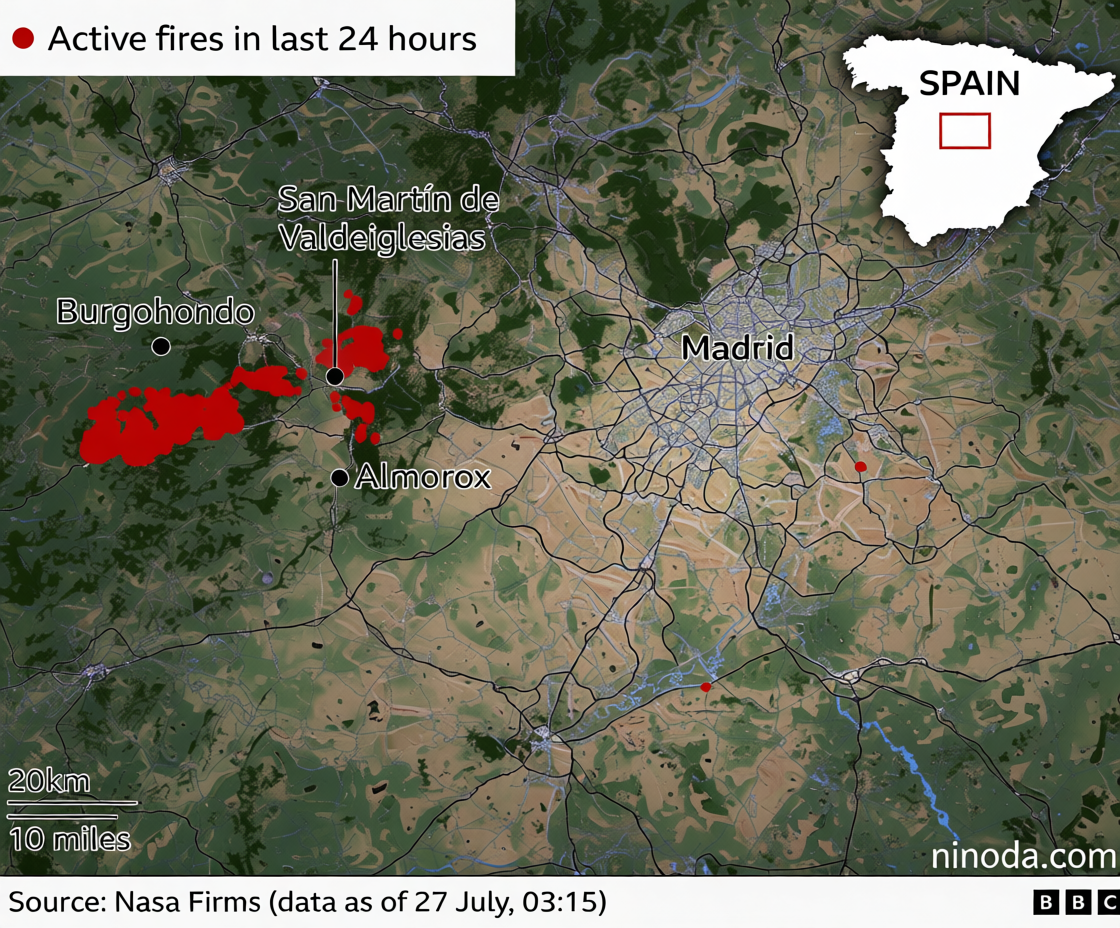
Authorities in the Spanish capital estimate that separate fires surrounding Madrid have consumed approximately 297 square miles (770 square kilometers) of land. This devastated territory exceeds the metropolitan area of Madrid itself. Francisco Martin, a government delegate for Madrid, characterized one of the active flames as “undoubtedly the largest fire in the history of the Madrid region.”
Gironde’s Unprecedented Evacuation
France’s most severely impacted zone centers on Gironde, situated near Bordeaux. More than 200,000 individuals have fled their residences as the flames advance. Within just four days, the inferno has devoured over 162 square miles (420 square kilometers)—an expanse roughly equivalent to four times the area of Paris. The blaze now sits merely nine miles (15 kilometers) from southern Bordeaux.
The advancing fires endanger critical military installations and industrial facilities operating within the vicinity. These vulnerable sites include operations handling French ballistic missiles, rocket propulsion systems, and hazardous chemical processing operations.
Fire Thunderstorms: A Rare Phenomenon
The intensity of these blazes has generated pyrocumulonimbus clouds—colloquially termed “fire clouds.” This uncommon meteorological occurrence develops when extreme heat from wildfires causes atmospheric air to ascend rapidly. This rising air transports smoke, ash, and moisture high into the atmosphere where cooling triggers condensation into cloud formations.
When atmospheric instability combines with sufficient fire power, these clouds evolve into cumulonimbus structures—the same cloud type responsible for traditional thunderstorms. Should these formations achieve adequate size, they generate lightning capable of igniting additional fires. Occasionally, such clouds also deliver hail and precipitation.
These volatile and unpredictable atmospheric conditions significantly complicate firefighting efforts across both nations.
Aerial and Ground Response Strategies
French emergency crews deploy aircraft equipped with fire retardant chemicals alongside specialized Canadair planes. These remarkable aircraft can extract 6,000 liters of water from lakes or ocean waters within twelve seconds, subsequently releasing the load directly onto active flames.
During particularly hazardous periods, fully loaded aircraft conduct patrols over vulnerable zones even before fires are detected, enabling them to respond within minutes of initial sightings. Aircraft frequently maintain continuous shuttle operations while chemical barriers form along fire perimeters and ground teams engage the flames directly.
Air Tractor AT-802F Fire Boss aircraft have operated in both countries, while French Air Force A400M military transport planes have delivered retardant over the Lacanau wildfire zone.
Personnel and Firebreak Construction
Gironde has mobilized approximately 2,500 firefighters, 1,500 military personnel, and 1,200 police officers and gendarmes to contain the destruction. Despite this substantial deployment, Gironde official Jean Luc Gleyze expressed concerns to the BBC regarding resource limitations.
“We don’t have enough people and enough trucks and even I think France don’t have enough,” he stated.
Near Lacanau, heavy machinery including bulldozers, excavators, and mechanical shovels have constructed firebreaks reaching 100 meters (328 feet) in width at certain sections. These cleared corridors remove all vegetation, eliminating potential fuel sources before flames can advance further.
Climate Change and Future Concerns
Spanish emergency teams employ similar containment techniques as their country faces what may become its worst fire season in twenty years. This summer’s intensified burning patterns connect to hotter, drier conditions driven by climate change—factors enabling flames to propagate more rapidly and burn with greater ferocity.
Many professionals working on the ground in both nations fear deteriorating conditions during the upcoming week. Forecasted high-pressure systems promise dry, stable weather with progressively rising temperatures.
The Gironde fires have devastated 162 square miles in less than four days, scorching forests and agricultural fields throughout the region. This tourist-favorite area borders the Atlantic Ocean, adding complexity to containment efforts as Spanish firefighters continue their struggle against the advancing flames.
“`