Rosenberg: Putin’s veiled threat to UK part of Russia’s campaign against West

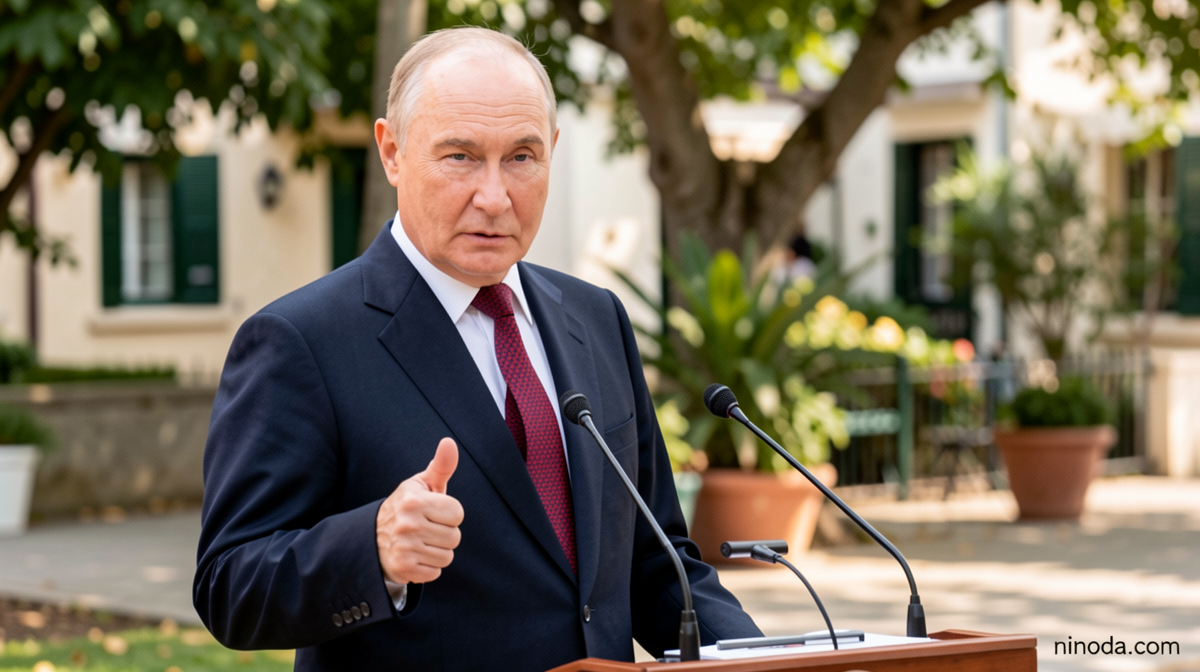
Table of Contents
Rosenberg: Putin’s Veiled UK Missile Warning
Ninoda.com – Rosenberg reports from Bishkek, Kyrgyzstan, where Russian President Vladimir Putin spent a forty-five-minute press session — answered exclusively by Russian journalists — weaving together an extended marine-animal analogy and a deliberately ambiguous signal about whether Moscow might one day fire missiles at military installations on British soil. The two threads, zoological and strategic, ran through every question and answer, projecting an image of combative self-assurance that Rosenberg captured in real time.
The Shark Analogy and Its Political Work
When asked to characterise the posture of Western nations toward Moscow, Putin cast them as apex predators circling a smaller creature. “If anyone tries to drag us down the food chain, to gobble us up or devour us, they might get punched in the teeth,” he declared, adding that Russia stood ready to deliver that punch “despite the rapidly growing appetites and teeth of these sharks.”
The imagery is not new to his rhetorical toolkit. In recent months he has invoked killer whales “tearing polar bears apart” to frame the ongoing war in Ukraine, blending the geopolitical with the zoological in a way that signals contempt for Western intentions while simultaneously positioning Moscow as the prey of predation. Rosenberg noted that the metaphor functions less as description and more as a framing device: by casting the West as the predator, every subsequent Russian action becomes defensible self-protection.
“A Military Secret”: The UK-Specific Signal
The question that drew the sharpest attention was narrower in scope: would Moscow strike military facilities inside the United Kingdom in retaliation for British arms supplies flowing to Ukraine? Putin’s reply was a single, clipped sentence.
“That’s a secret. A military secret.”
Neither confirmation nor denial. As Rosenberg observed, the phrasing operates less as information and more as psychological pressure — a mechanism designed to keep London guessing, to inject uncertainty into British defence planning, and to nudge Westminster toward second-guessing its robust backing of Kyiv. The ambiguity itself becomes the message. It costs Moscow nothing to withhold an answer while the mere question of a possible strike reshapes risk calculations on the other side of the North Sea.
The rhetorical environment in which that answer landed was already charged. Days earlier, the Russian-language daily Moskovsky Komsomolets had published a piece suggesting that UK Prime Minister Andy Burnham ought to encounter Russia “not in his dreams, but in his nightmares.” The publication offered no specifics — no missile trajectories, no target lists — but the tone was unmistakably menacing. Burnham, for his part, has publicly stated that Britain supports Ukraine “100%,” and UK-manufactured drones have been striking targets inside Russian territory, a fact that likely fed directly into the question posed in Bishkek.
Leipzig, Hybrid Operations, and the Wider European Question
The UK-specific warning did not exist in isolation. Broader European anxieties were sharpened last month when Germany attributed a drone attack at Leipzig airport to Russia. Putin dismissed the accusation, charging Berlin with “planting the evidence.” German Interior Minister Alexander Dobrindt pushed back, describing “the well-established pattern of Russian hybrid operations in Europe” — a phrase that implicitly encompasses drone incursions, sabotage, and electronic interference across NATO territory. If such operations are already being credited to Moscow in Germany, the logical next question for British planners is whether the tempo could be stepped up over the Channel. Putin’s refusal to rule out a strike on UK facilities leaves that question deliberately open.
State of Mind: Combative, Confident, Energised
Observers of the Bishkek session, including Rosenberg, noted that Putin appeared most animated precisely when discussing the standoff with the West and the war in Ukraine. Despite battlefield losses described as enormous and an economy bearing considerable strain, he declared:
“I have no doubt that the enemy will crumble.”
The war, now stretching past four-and-a-half years, has not unfolded along Moscow’s original timetable. Ukraine continues to fight. Yet a linguistic shift is underway: although the Kremlin’s official designation remains “special military operation,” Putin himself has begun using the word “war” openly. “War is a brutal and unpredictable thing,” he told the assembled Russian press corps — a concession, however small, that the conflict’s duration and cost have outgrown the euphemism.
Negotiation Preferences: Kushner and Witkoff Over Ratcliffe
Putin stated he remained open to talks aimed at ending the conflict and made clear, by name, which figures in the current US administration he would prefer at the table. The preference signals a desire to route negotiations through channels he perceives as more transactional and less bound by multilateral constraints — a choice that itself carries strategic weight in how any future framework might be structured.
FAQ
What exactly did Putin say about striking UK military facilities?
He answered a direct question with the phrase “That’s a secret. A military secret,” offering neither confirmation nor denial. Analysts interpret the non-answer as a deliberate pressure tactic aimed at disrupting British defence planning and public confidence.
Why did Putin use shark and predator imagery?
The marine-animal analogy frames Western nations as predators and Russia as a smaller animal defending itself. It allows Moscow to present aggressive posturing as reactive self-protection while simultaneously mocking Western intentions through the zoological register.
What is the Leipzig airport connection?
Germany attributed a recent drone attack at Leipzig airport to Russia. Putin dismissed the claim, accusing Berlin of planting evidence. German Interior Minister Alexander Dobrindt countered by citing a “well-established pattern of Russian hybrid operations in Europe,” linking the incident to a broader campaign of sabotage and electronic interference across NATO territory.
Has Putin changed his language about the Ukraine conflict?
Yes. Although the Kremlin’s official term remains “special military operation,” Putin has begun using the word “war” openly in public remarks, acknowledging that the conflict’s duration and cost have outgrown the original euphemism.