‘What was their crime?’: BBC visits Iran school where strike killed 120 children

A School Transformed: Remembering the Minab Tragedy
Walking Through the Remains
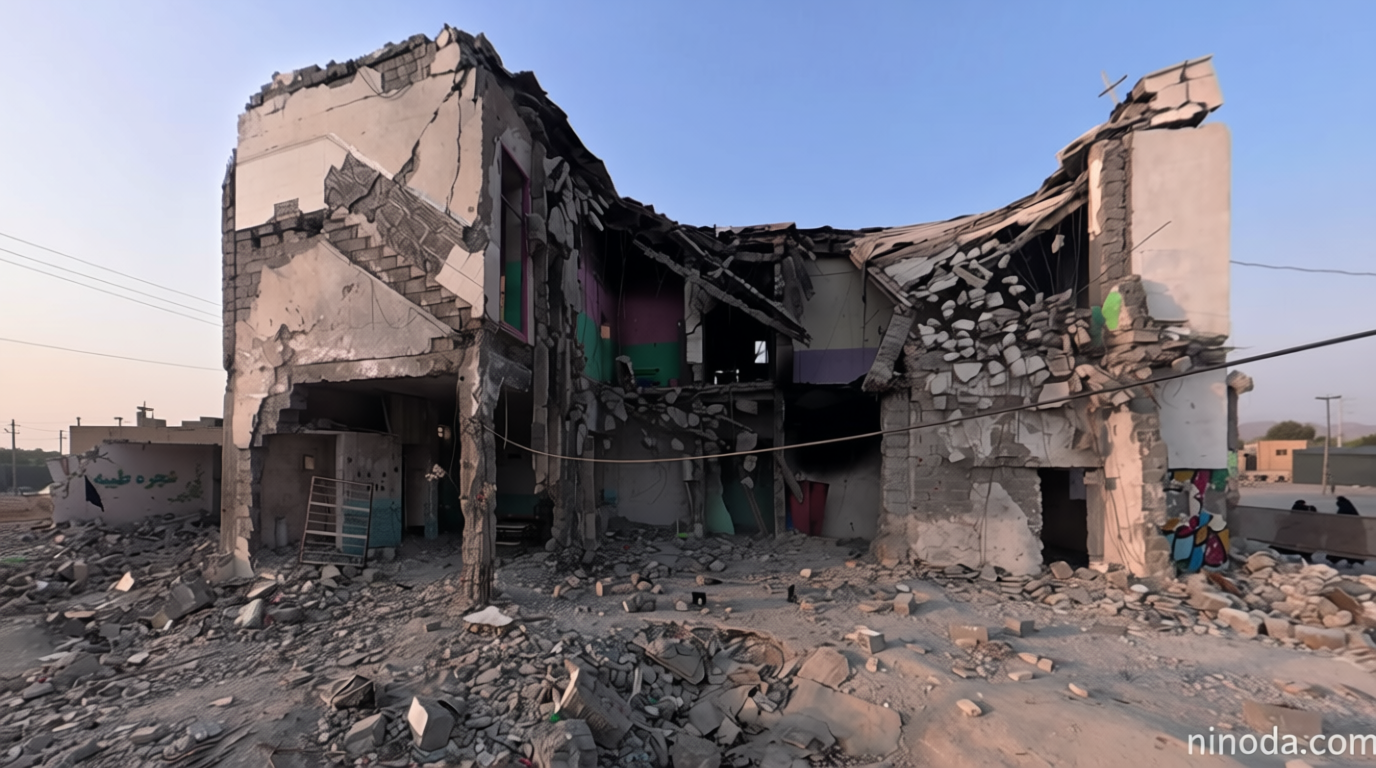
Ninoda.com – Amaineh Nademi moves cautiously among the debris of her former workplace. Fragments of concrete dangle dangerously from the ruined second story. Several rooms still stand intact, their vibrant walls adorned with hand-painted balloons and floral designs. The thirty-three-year-old educator remembers every corner precisely—the girls’ section upstairs, the boys’ area downstairs, the principal’s office, and the prayer space.
Only rubble survives from her classroom, where she instructed first-grade girls at Shajareh Tayyebeh Primary School. This educational institution sits in Minab, a modest town located in southern Iran. Even now, children’s chairs and decorated surfaces remain visible within the damaged sections.
The Day Everything Changed
February 28 marked the beginning of hostilities between the United States and Israel against Iran. During those initial hours, an aerial attack on the school turned a routine Saturday morning into one of the conflict’s most devastating moments for ordinary people. According to Minab’s prosecutor’s office, the death toll reached 156 individuals, with 120 being children. Among the victims was a pregnant woman alongside her unborn child.
Analysts suggest that American military forces struck the educational facility. Satellite photographs reveal that the school, positioned adjacent to an Islamic Revolutionary Guard Corps compound, experienced multiple impacts. While Washington has not officially acknowledged involvement, American news outlets report that military investigators consider it probable that US forces conducted the attack unintentionally.
Memories of the Strike
The anguish remains fresh for everyone connected to this place. Educators visit daily to offer prayers at the location. Search teams continue their efforts to recover remains of those who perished.
Amaineh recalls how the morning began normally. Since the Islamic holy month of Ramadan was underway, students assembled inside the prayer hall to recite passages from the Quran. Afterward, she started teaching her pupils a new character from the Persian alphabet.
As attacks spread across Iran, the headteacher announced the school would close. Teachers immediately began calling parents, asking them to come retrieve their children quickly.
“Just as I went to leave, a missile struck the school,” says Amaineh. “Something hit my head and my students’ heads – we were all sent flying.”
Only five of her fifteen first-grade students remained upstairs when she first heard an explosion nearby. She had been in the corridor and rushed back to gather the children.
“You can’t call it a school,” says Amaineh – just “walls that smell of death, grief and the blood that was shed here”.
Thick black smoke soon filled the room. She could barely see the children she held in her arms. Breathing became difficult. Another explosion followed, accompanied by screams and crying children. Then the entire building collapsed.
“Blood was pouring from me and the students,” she adds.
Survivors and Victims
When the smoke momentarily cleared, Amaineh carried injured children down to people waiting below. She climbed past flames and debris toward the school gate, where she found a crowd of parents. Many had arrived without even putting on shoes.
Confused and shocked, she could not understand why parents were running toward the school. She believed everyone had already escaped. She did not realize that all of them were trapped beneath the rubble.
Amaineh had taught first grade at this school for six years. She remembers the names of those lost that day: Adrina, who died on the stairs with her mother Fatemeh; a second-grade student named Fatemeh; and numerous others, including sixth-grade pupils she had taught the alphabet to. The headteacher, deputy head, physical education teacher, and Quran teacher also perished.
Emergency responders arrived within minutes. Reza Besharati, a worker wit