White House defends Argentina team over Falklands banner

White House Backs Argentina’s Free Speech in Falklands Controversy
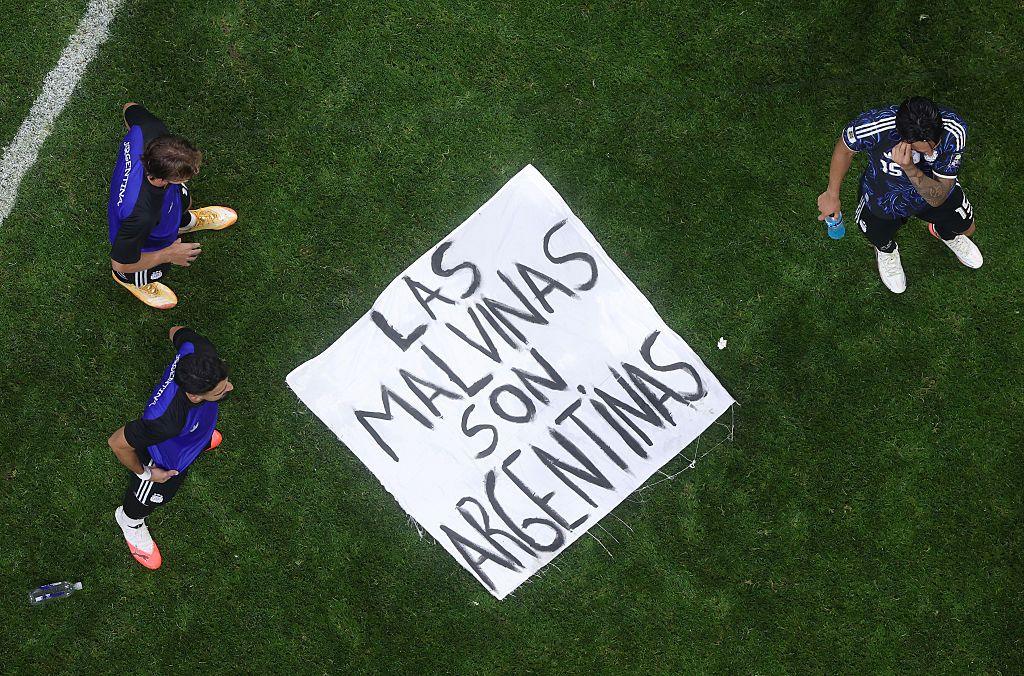
Ninoda.com – The White House has taken a firm stance in defense of Argentina’s football team following their controversial display of a banner supporting the country’s claim to the Falkland Islands. The incident, which occurred during a World Cup match against England, has sparked a heated debate over the boundaries of free expression in international sports. The administration emphasized that the players’ actions were a legitimate exercise of their right to free speech, underscoring the importance of political expression even in the context of a global tournament.
A Banner of National Pride and Political Statement
Argentina’s players raised a banner reading “Las Malvinas son Argentinas” (“The Falklands are Argentine”) after their semi-final victory, a moment that captured the nation’s emotional connection to the disputed territory. While the gesture was celebrated as a symbol of patriotism, it also raised concerns about whether the action violated FIFA’s guidelines on political messaging in sports. The White House, through its FIFA task force, has argued that such displays are not only permissible but encouraged, framing them as a reflection of Argentina’s cultural identity and historical aspirations.
“We believe in our First Amendment rights here in the United States of America,” stated Andrew Giuliani, head of the White House’s FIFA task force. “The players have the right to express their country’s position, and we stand by them.”
The UK government, however, has expressed disappointment with the move, insisting that the Falkland Islands are an integral part of British sovereignty. A spokesperson from Downing Street reiterated that the territory “definitely” belongs to the UK, while urging FIFA to investigate the incident thoroughly. The British stance highlights the ongoing tension between the two nations, with the dispute dating back to the 1982 Falklands War, a conflict that remains a pivotal moment in their geopolitical relationship.
Historical Context and the Legacy of the Falklands War
The Falkland Islands, a British overseas territory in the South Atlantic, have been a flashpoint of territorial contention for decades. The 1982 conflict, in which Argentina invaded the islands and Britain launched a military task force to reclaim them, resulted in the loss of 255 British soldiers, three islanders, and 649 Argentine troops. This historical event has deeply influenced the current diplomatic climate, with the UK maintaining a strong commitment to the territory’s status. In 2013, a referendum on the islands’ future saw 1,517 voters, with 1,513 supporting British sovereignty—a near-unanimous endorsement of the UK’s claim.
Despite the UK’s firm position, the White House’s defense of Argentina’s team has drawn attention to the broader implications of political expression in sports. The administration’s support has been seen as a nod to Argentina’s right to assert its historical narrative, even as it aligns with the interests of a nation that values free speech. This stance has also raised questions about FIFA’s role in regulating political statements, with critics arguing that the organization should strike a balance between upholding neutrality and allowing players to express national pride.
Meanwhile, Argentina’s vice-president, Victoria Villarruel, has reinforced the country’s emotional bond with the Falklands, sharing a social media post that highlighted the significance of the territory in national identity. “It wasn’t just another match,” she wrote, accompanied by footage of Argentine soldiers, underscoring the deep-rooted pride the nation feels toward its historical claims. The White House’s defense of the team has thus been interpreted as a gesture of solidarity with Argentina’s cultural and political values.
As the debate continues, the incident has reignited discussions about the intersection of sports and geopolitics. While some view the banner as a patriotic celebration, others argue that it could undermine the tournament’s neutrality. The White House’s involvement, however, has added a layer of diplomatic significance to the controversy, positioning the U.S. as a supporter of Argentina’s right to express its political identity on the global stage. This support may also reflect broader U.S. interests in maintaining strong ties with Argentina, particularly in the context of international relations and cultural diplomacy.