Do declassified files support Trump’s election security claims?

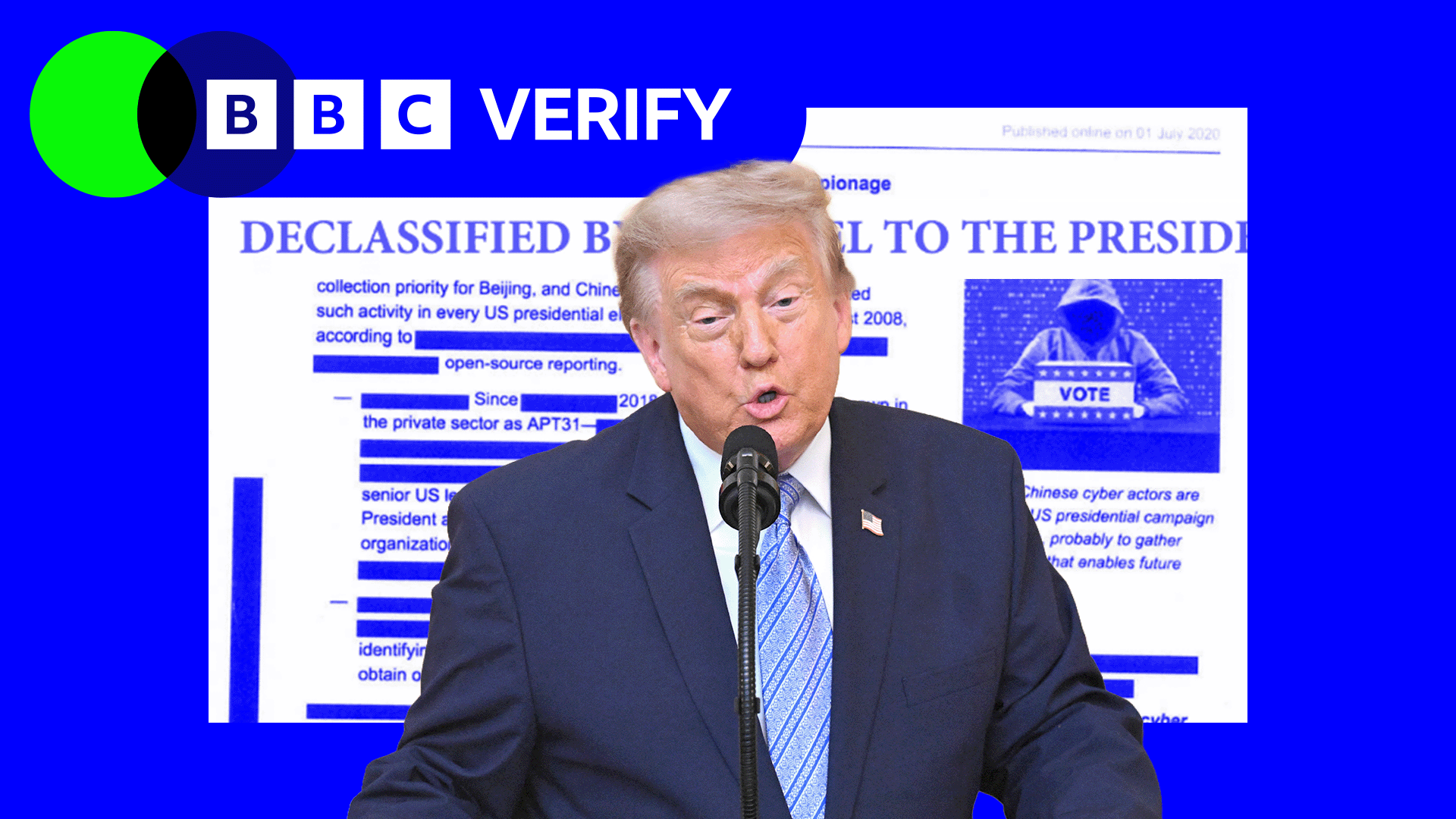
Do Declassified Files Support Trump’s Election Security Claims?
Ninoda.com – Do declassified files support Trump’s claims about election security? In a recent 26-minute speech at the White House, former President Donald Trump reasserted allegations of widespread election fraud and foreign interference, drawing heavily on hundreds of declassified intelligence reports. He emphasized “shocking vulnerabilities” in the voting system, framing these documents as irrefutable proof of systemic weaknesses. The address, held in the East Room—a location historically significant for presidential announcements—sought to revive the narrative that the 2020 election was compromised, despite the absence of conclusive evidence in the reviewed materials.
BBC Verify conducted a thorough analysis of the declassified files, uncovering several redacted sections that left critical details ambiguous. While the documents highlighted potential risks to election integrity, they did not establish a direct link between foreign interference and the final results of the 2020 presidential contest. The findings suggest that Trump’s reliance on these files may be more about reinforcing his political message than presenting definitive proof. This raises questions about the extent to which the declassified files actually support Trump’s claims or merely serve as tools for his argument.
Trump’s Narrative and China’s Role
Trump’s rhetoric consistently centers on identifying a clear antagonist, often casting foreign entities as threats to American democracy. In this speech, he singled out China, portraying it as a “sinister” force engaged in election meddling. The declassified files cited by the administration referenced Chinese efforts to gather voter data, with some reports openly acknowledging that this information was available for purchase. However, the documents did not provide conclusive evidence of large-scale manipulation or interference in the 2020 election.
“Over years, the People’s Republic of China executed what is considered the largest data breach in election history, acquiring 220 million voter files,” Trump asserted in the speech.
The White House released four batches of “election integrity” documents, one of which dated July 13, 2026, claimed that the PRC compromised voter registration data from 18 states. Though the files listed over 200 million records, the redactions made it difficult to determine the exact scope of the breach or its impact on election outcomes. Analysts noted that the documents were often vague, leaving room for interpretation.
Comparisons to Past Threats
The declassified files frequently referenced Russian interference in the 2016 election, a claim that has been widely debated in subsequent years. However, the documents only made a single mention of Russian activities in the context of the 2020 election. A 2021 National Intelligence Council (NIC) report, for instance, concluded with “high confidence” that China did not disrupt the 2020 contest. This contrast between the 2016 and 2020 elections underscores the evolving nature of election security threats and the selective use of evidence by Trump’s administration.
Historical context reveals that concerns about election fraud are not new. The 2000 election, marked by the controversial “hanging chad” incident in Florida, prompted significant reforms to voting systems. These efforts were later intensified following the 2016 election, when cybersecurity vulnerabilities were highlighted. Despite these improvements, the 2020 election was still described as having “vulnerabilities,” though the NIC report found no proof that these were exploited to alter results. The declassified files, therefore, seem to reflect a broader narrative rather than a definitive case for Trump’s claims.
Expert Analysis and Evidence Evaluation
Experts have scrutinized the declassified files to assess their validity in supporting Trump’s election security claims. While the documents outline potential risks, such as data breaches and cyber threats, they lack the specificity needed to confirm large-scale interference. The emphasis on China as a key player in the alleged fraud aligns with broader geopolitical tensions, but the evidence remains circumstantial. For example, the files mention the PRC’s data collection efforts, but they do not establish a clear connection to the 2020 election results. This has led some analysts to question whether the documents were used to bolster a preexisting narrative rather than provide new insights.
The inclusion of redacted sections in the files adds to the ambiguity. While the White House presented these documents as critical evidence, the missing information makes it challenging to fully evaluate their significance. This has sparked discussions about the transparency of the intelligence community and the extent to which declassified materials are being leveraged for political purposes. Trump’s speech, which heavily featured these files, sought to frame them as definitive proof of election insecurity, even as their content remains open to debate.
The Broader Implications of the Claims
Trump’s focus on election security has had lasting implications for public perception. By repeatedly citing the declassified files, he aimed to question the legitimacy of the 2020 election and position himself as a defender of democratic processes. This strategy has been part of a broader effort to challenge the outcome of the 2020 election, with the files serving as a key component of his argument. The reiteration of these claims, despite the lack of conclusive evidence, highlights the role of declassified materials in political discourse and their potential to influence voter sentiment.
While the declassified files offer a glimpse into the intelligence community’s assessment of election risks, they do not fully substantiate Trump’s assertions. The documents emphasize potential vulnerabilities but stop short of proving that they were exploited to change the election results. This leaves room for alternative interpretations, with some viewing the files as a strategic tool to reinforce skepticism about the electoral process. As the 2020 election’s outcome remains a focal point of political debate, the role of these declassified files in shaping the narrative continues to be a subject of analysis and scrutiny.