Watch: Will Ukraine get the support needed as tensions with US rise?

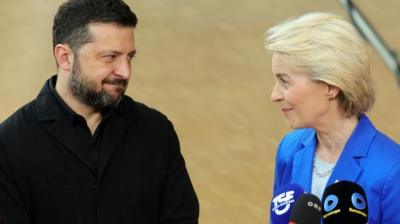
Table of Contents
European Support Comes Into Focus as Ukraine Faces Strain With Washington
Ninoda.com – Ukraine’s relationship with its European partners was on prominent display in Brussels as President Volodymyr Zelensky praised the backing his country has received from the European Union during a period of growing tension with the United States.
Standing alongside European Commission President Ursula von der Leyen and European Council President António Costa, Zelensky thanked EU leaders for their continued support. His appearance came as Ukraine seeks to maintain international political, military and economic assistance while the wider diplomatic atmosphere around the war remains unsettled.
“Real leaders.”
Zelensky used the phrase to describe the heads of state and government gathered in Brussels. The remarks underlined Kyiv’s effort to reinforce close ties with Europe at a consequential moment for Ukraine’s defence and its longer-term future.
A Test of International Backing
The war has placed Ukraine’s partnerships under intense scrutiny. European countries and institutions have become central to the country’s ability to withstand Russia’s full-scale invasion, providing a combination of financial support, humanitarian assistance, military aid and political solidarity.
For Ukraine, European backing is not solely a matter of immediate battlefield needs. It is also closely linked to the country’s ambitions for security, reconstruction and deeper integration with Europe. Meetings involving senior EU figures therefore carry significance beyond the statements made at a single event.
Zelensky’s comments in Brussels highlighted the value Kyiv places on a united European response. The presence of von der Leyen and Costa beside him also conveyed institutional support from the European Commission and the European Council, two key centres of decision-making within the EU.
European leaders face the continuing challenge of sustaining assistance over time while managing domestic political pressures, defence-production limits and broader concerns about the future direction of transatlantic relations. Ukraine, meanwhile, remains dependent on dependable external support as it confronts a much larger military opponent.
Trump Criticises Refinery Strikes
At the same time, President Donald Trump criticised Ukraine’s renewed strikes on Russian oil refineries. He described the resumption of those attacks as a disgrace, adding another point of friction to the increasingly difficult relationship between Kyiv and Washington.
Attacks on oil infrastructure have strategic implications because refineries process crude oil into fuels used by consumers, transport networks and industry. Energy facilities can also be important to a country’s wider economic capacity. In wartime, strikes on such sites can be viewed as an attempt to disrupt supply, reduce revenue or place pressure on an opponent’s logistics.
Ukraine has repeatedly argued that it must be able to defend itself and weaken Russia’s capacity to continue the war. Russia has launched extensive attacks against Ukrainian cities, energy systems and civilian infrastructure since the invasion began, leaving Ukraine to balance defensive priorities with the political concerns of its allies.
Trump’s criticism of the refinery strikes illustrates how military decisions can carry diplomatic consequences. Even where Ukraine and its partners share broad opposition to Russia’s invasion, they may differ over tactics, escalation risks and the best way to pursue an end to the conflict.
Why Brussels Matters
Brussels is a natural setting for discussions about Ukraine’s future because it is home to major EU institutions and remains a focal point for collective European policy. Decisions made there can influence sanctions, funding arrangements, defence cooperation and the pace of Ukraine’s path toward closer European integration.
For ordinary Ukrainians, continued international backing can affect far more than high-level diplomacy. It can shape the availability of air-defence systems, support for public services, help for displaced people and the resources needed to repair damage caused by the war.
European support also matters as a signal of political endurance. Russia’s invasion has developed into a prolonged conflict, and Ukraine’s leaders have consistently sought assurances that partners will not allow attention or assistance to fade as the war continues.
Zelensky’s public gratitude toward EU leaders therefore carried a clear message: Kyiv sees Europe as an essential partner at a time when its ties with the United States are under pressure. The contrasting remarks from Brussels and Washington reveal the difficult diplomatic landscape Ukraine must navigate while continuing its fight against Russia.
The immediate debate centres on support, military strategy and the limits of escalation. The longer-term question is whether Ukraine can retain a stable coalition of partners willing to provide the assistance it says is necessary for its security and survival.
Related Reading
Frequently Asked Questions
What is Watch: Will Ukraine get the support needed as tensions with US rise??
Watch: Will Ukraine get the support needed as tensions with US rise? is the main topic of this guide. The article explains the context, practical details, and next steps readers should understand.
Why does Watch: Will Ukraine get the support needed as tensions with US rise? matter?
Watch: Will Ukraine get the support needed as tensions with US rise? matters because readers are looking for a useful answer, not just a short summary. Good content should match search intent and help them decide what to do next.