Violent clashes, looting and buildings ablaze in France as over 1,000 arrested after protests

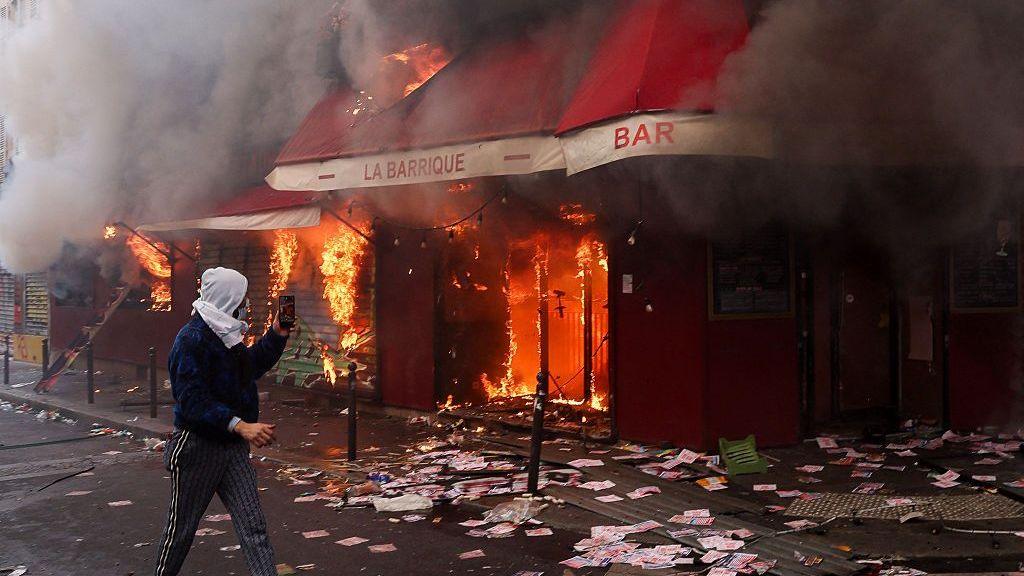
Table of Contents
More Than 1,000 Arrested as Protests Across France Turn Violent
Ninoda.com – France saw one of its most turbulent days of protest in recent years on Saturday, as demonstrations over conditions in secondary schools and the rising cost of living were followed by fires, looting and confrontations with police in cities across the country.
An estimated 550,000 people joined the nationwide mobilisation. The French government said at least 1,200 people were arrested as unrest intensified, while Prime Minister Sébastien Lecornu said 150 police officers were injured.
What began with large marches that were often calm during the afternoon became increasingly volatile in parts of the country after nightfall. In Paris, police deployed tear gas and water cannon as clashes continued into the evening. Some groups set street fires and burned vehicles, including at Place de la République in the city centre.
Damage in Paris and regional cities
Several businesses in the capital were targeted. Shops selling clothing and food were raided, a restaurant was severely damaged by fire, and La Barrique bar was also set alight. Fighting was seen between some groups of people, while riot police charged one crowd in central Paris and struck several individuals with batons.
The destruction was not limited to the capital. In Lyon, the city’s tourist office caught fire. Mayor Grégory Doucet described the blaze as a painful loss for Lyon because of the building’s historic and symbolic importance. Police said firefighters had difficulty approaching the site safely because of hostile behaviour nearby.
“It breaks our hearts because it’s a very iconic, well-known historic building.”
Limoges town hall was also heavily damaged. A major fire caused part of its roof to collapse, and the local prefecture said the building was largely lost. Other damage was reported in Grenoble, Avignon, Pau, Montpellier and Valence.
In Lille, an Apple store was broken into and emptied. In Grenoble, authenticated footage showed masked men driving a tourist train down a narrow central street in the direction of at least three riot police officers.
Violence spreads beyond the main marches
The interior ministry said hooded people carried out targeted violence in several locations. Along with Paris, incidents were cited in Marseille, Rennes, Toulouse and Angers. The day’s disorder included attacks on businesses and city halls as well as vandalism and arson.
In Saint-Étienne, Mayor Régis Juanico said a young man had lost his hand after a grenade exploded. He called the incident a tragedy that should never have occurred.
“Such a tragedy should never have happened.”
Many demonstrators had gathered to press concerns that had been building for weeks. Students have protested over shortages of staff and deteriorating buildings in France’s lycées, which serve pupils aged 15 to 18. Saturday’s crowds also included trade union members and wider activist groups.
Among those present were supporters of the gilets jaunes, or yellow vest, movement. That movement emerged in 2018 in opposition to increased living costs and continued for more than a year, becoming one of the longest-running protest movements in modern French history.
Not everyone in the Paris crowds supported the violence. A group of young people said they were peaceful protesters trying to force change amid frustration that their concerns had not produced results.
“We’re just trying to make things change, but nothing is moving.”
A tense political backdrop
The unrest comes as France approaches a period of major political uncertainty. President Emmanuel Macron is due to leave office next year, and polling has suggested that April’s presidential contest could become a contest between Marine Le Pen, leader of the National Rally, and Jean-Luc Mélenchon of the hard-left La France Insoumise party.
Mélenchon joined demonstrations and criticised police conduct, accusing officers of “unleashing” on protesters. At the same time, he condemned both looting and arson.
Lecornu rejected Mélenchon’s comments, calling them dangerous and cynical. The prime minister said officers had faced exceptionally intense violence and argued that some groups were treating the demonstrations as preparation for the presidential campaign.
“No-one will impose their political agenda through violence.”
Le Pen said the legitimate concerns expressed by protesters had been taken hostage by the far left, and accused Mélenchon of contributing to the escalation.
France has a long tradition of large-scale street protest, with demonstrations often serving as a major channel for public pressure over social and economic policy. Saturday’s events, however, showed how quickly a broad movement built around education and household hardship can be overshadowed by damage, arrests and violent confrontation.
The immediate challenge for authorities will be restoring calm while addressing the grievances that brought students, workers and other groups onto the streets. For communities affected by fires and looting, the day also leaves a more immediate burden: repairing damaged public buildings, businesses and neighbourhood spaces after a protest movement fractured into sharply different forms of action.
Related Reading
Frequently Asked Questions
What is Violent clashes looting and buildings ablaze?
Violent clashes looting and buildings ablaze is the main topic of this guide. The article explains the context, practical details, and next steps readers should understand.
Why does Violent clashes looting and buildings ablaze matter?
Violent clashes looting and buildings ablaze matters because readers are looking for a useful answer, not just a short summary. Good content should match search intent and help them decide what to do next.